
Air and gas need a controlled way out of pharmaceutical and biotech process systems.
But in a sanitary environment, simply adding a vent point is not enough.
The valve responsible for that function has to release air or gas reliably while maintaining the cleanability, material traceability, and process integrity expected throughout the rest of the fluid path.
That is the role of a sanitary vent valve.
Fluid Line Technology’s Sanitary Vent Valves are designed specifically for sterile and high-purity process applications where controlled venting, hygienic design, and complete documentation all matter at once.
What Is a Sanitary Vent Valve?
A sanitary vent valve provides a controlled point for releasing trapped air or gas from a process line, vessel, tank, or utility loop.
In biotech and pharmaceutical systems, that function may be required during:
- Startup
- Filling
- Draining
- CIP cycles
- SIP cycles
- Vessel operation
- Routine process venting
The challenge is performing that function without introducing an unnecessary contamination risk or creating a component that is difficult to clean and validate.Sanitary vent valves are engineered to solve that problem within a high-purity process environment.
Inline Sanitary Vent Valves
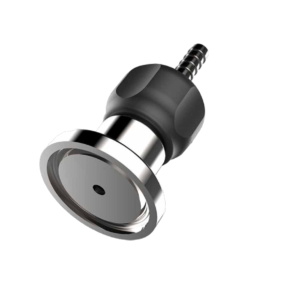
Inline vent valves are designed for process layouts where straight-run installation and a compact footprint are priorities.
They are particularly well suited to vertically aligned pipelines where a vent point needs to be added without introducing excessive complexity into the system layout.
Fluid Line Technology’s inline sanitary vent valves are precision-machined for reliable, repeatable venting and use a solid handle for manual air release.
Key advantages include:
- Minimal installation footprint
- Straight-run configuration
- Simple operator control
- Reliable venting performance
- Strong fit for space-constrained vertical installations
For systems where piping geometry is already tight, the inline configuration can provide a practical venting solution without requiring major layout changes.
Angle Sanitary Vent Valves
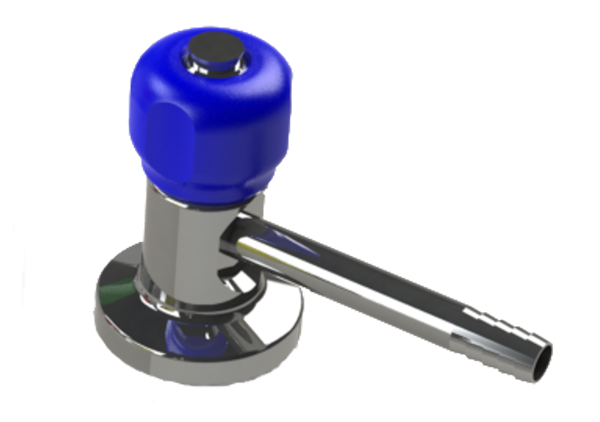
Angle vent valves provide the same core venting function in a 90-degree configuration. That geometry can be useful where system accessibility, orientation, or drainability makes an inline design less practical.
The angle configuration allows engineers greater flexibility when determining where operators will access the valve and how the vent point will integrate with the surrounding process equipment.
Typical advantages include:
- Improved access in certain piping layouts
- Flexible installation orientation
- Pressure-rated manual operation
- Better fit where a 90-degree outlet improves system design
Choosing between inline and angle configurations ultimately depends on the process layout rather than one configuration being universally preferable.
Designed for Sanitary Processing
The biggest difference between a general-purpose vent valve and a sanitary vent valve is everything surrounding the venting function.
In pharmaceutical and biotech environments, the valve must also support the sanitary requirements of the process.
Fluid Line Technology’s Sanitary Vent Valves feature:
- ASME BPE-compliant sanitary design
- CIP and SIP compatibility
- Autoweld or clamp-end connections
- Sanitary stainless steel construction
- Pressure testing and leak verification
- Material Test Reports for full traceability
- Custom configuration options
These features allow the vent valve to become part of the validated fluid path rather than an exception to it.
Why CIP and SIP Compatibility Matter
Vent valves are often installed in systems that undergo regular Clean-in-Place and Steam-in-Place cycles.
That means the geometry of the valve must allow cleaning solution and steam to effectively reach wetted surfaces.
A vent point that performs well mechanically but creates a difficult-to-clean area can introduce unnecessary risk into an otherwise sanitary process system.
For that reason, vent valve selection should consider cleanability at the same time as pressure rating, orientation, and connection type.
Where Sanitary Vent Valves Are Used
Common applications include:
- Biopharmaceutical process venting
- Fermentation vessels
- Sterile storage and process tanks
- Vertical process piping
- CIP loops
- SIP loops
- Air and gas release points throughout high-purity systems
Each application creates slightly different design requirements.
A fermentation vessel may prioritize reliable air release and operator access.
A vertical process line may prioritize footprint.
A CIP or SIP loop may place greater emphasis on cleanability and drainability.
That is why configuration matters.
Documentation Is Part of the Product
In a validated pharmaceutical or biotech system, the physical valve is only part of what the customer needs.
Material traceability matters too.
Fluid Line Technology provides MTRs with its sanitary vent valves so customers can document the materials used in the component and support qualification requirements.
For high-purity manufacturing environments, that documentation is not an administrative extra.
It is part of the component’s usability inside the process.
A Simple Function With High-Purity Requirements
The purpose of a sanitary vent valve is straightforward:Give air and gas a controlled way to leave the system.
But accomplishing that reliably in a pharmaceutical or biotech environment requires more than a basic valve.
The component has to seal.
It has to clean.
It has to fit the system.
And it has to be fully documentable.
That is what makes sanitary vent valve design important.
Whether the application calls for an inline or angle configuration, the goal is the same:
Controlled venting without compromising the integrity of the process.